
The April Editor's Pick is by Chris Castle
Please feel free to visit Chris at: chriscastle76@hotmail.com
THE FLOCK
by Chris Castle
Jacob walked back ten paces and looked at the field. The crop was thriving.
He mopped his brow and replaced his hat. For a moment he sat, resting the sickle beside him on the grass. The sun was still strong, even though the day was late. It should have been a fine day.
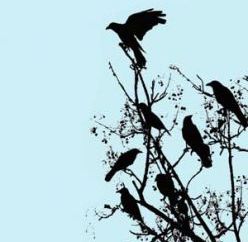
He looked beyond the falling sun and saw the endless flocks of birds in the trees. Black blood across the perfect scene. There seemed to be more than before, making the trees sag under their weight. They made no sound. They were still in the branches. He stood and gathered his sickle, wondering why the birds did not act like they were supposed to and why it scared him so.
He had heard the rumours, of course. The man in the neighbouring farm claimed that the flocks had ravaged the next town over, swarming through houses like dark, angry angels, ravaging the sinners for their ways. The man claimed the birds were of no defined species, but rather a breed made by god to wreak justice in His name. Jacob had listened until he could stand it no longer. Even as Jacob was walking away, the man had stilled continued with the story, claiming the sinners would be purged by the flock, torn asunder by God’s servants. The man had used his fingers to demonstrate their oversized beaks, their sharpened talons. His neighbour was either mad or a fool, yet Jacob could not help but be a little affected by the story.
Jacob walked back to the farmhouse with the crazed man’s story still heavy in his ears. He called out for his wife and heard nothing. He set down the tools and walked to the back of the house, pulling at the loose buttons of his shirt. The heat was too much for him and he felt the constant hum of his skin nearly burning from dawn until dusk. He looked over to the water pail and suddenly there she was, and what he saw stopped him in his tracks.
She stood naked, her dress discarded nearby on the dirt. She pumped the water onto herself, ran her hands up and down her arms. She smiled as she did this, as if she took pleasure in the sight of her body, how beautiful it was.
He stood frozen; he could not have called out even if he had wanted to. Instead he stood, a stranger to his own wife and watched her as if he were an intruder. Watched her as she ran her fingers through her long hair, arched her neck back as she moved closer to the water.
Finally she looked back, seeing him, but she did not flinch. It was as if she expected an audience to watch this…performance. Jacob thought, And if not me, then…
The idea sent a stab into his heart. And all the while he was standing there, gaping at her, she said nothing. Instead, she simply reached out her hand and beckoned him forward, leaving him with no choice but to follow her unspoken command.
That night, he lay awake as she slept next to him. She lay so close that she was almost inside of him, coiled and sleek, like gold inside his arms. He did not understand her, this he knew with certainty. He did not understand how easy she was with her own body, how she carried herself. In truth, he did not understand why she had picked him at all over the many suitors to be his wife. On some nights, there was a nagging inside him that he was not party to some trick.
They rarely spoke to each other, if he faced the facts of it. Instead the one body collided with the other, a frenzy of kissing and reaching, movement and force and then it was nothing more than silence, half sentences rarely finished.
And during the days, she tended the farmhouse while he worked the fields. She kept the Bible close by though he had never seen her pick it up and open the thing, as if it was more for his benefit than her own. They were strangers in the long hours when they did not touch each other.
The heat of the summertime was becoming unbearable. He lost hours where he had to seek shade for fear of collapsing, meaning he had to work longer hours in the evening. Days passed where they spoke little more than a few words to each other. When he came in for lunch, he ate in silence at the empty table, hearing her in another room, aware of her even as she grew further out of reach.
And then one morning, he climbed out of the bed, careful not to disturb her. He walked to the window and looked out to the fields. He used to be soothed by the vastness of it all, but no longer. Now, he was aware of how isolated they were from the town, the community.
He looked deeper into the darkness and saw the trees sway, though there was no air in the night. He squinted to see the flock and felt sure that somewhere amongst those birds, a few specks of black blood twitched in the branches.
When Jacob went outside, the neighbour who had told him about the flock appeared at the edges of his field. He was not alone; a young man stood by the side of him, smiling without joy and looking aggrieved at the idea of work. He introduced himself as the old man’s son and Jacob shook his hand.
“The flock is gathering near,” the young man said, after they had listened to the old man’s diatribe once more. “I left that town at the start of the summer, saw the damage it did. It was like a storm had torn through every one of those houses, leaving nothing but the blood and the fear in their faces.” He told the story proudly, smiling when the old man no longer looked his way, as if he enjoyed recounting the horrors.
Jacob nodded, wishing they would leave him alone. He was tired, the heat having seared into him in a way that no other season could do. But despite his weariness, he found himself inviting the two of them back for water and bread, having picked up on the old man’s pleading and the young man’s brazen requests. The three of them set out for the house, each of them turning from time to time, monitoring the flock from set distances, each uncertain if they were more in number or less, as the birds still stayed almost frozen in the branches.
As they reached the farmhouse, Jacob froze in shock. His wife stood at the bedroom window, bare from the waist up, holding a garment up to her, gazing in the unseen wall mirror. Jacob felt his flesh roar with blood. He dropped the sickle onto the dirt, clanging it loudly against the gatepost, causing her to turn and press the garment to her breast. Jacob crouched to retrieve the tool, looking to his companions from the ground as he did. The old man merely sighed, wiping his brow, turning back and forth to the faraway trees, forever on watch for the flock.
But the younger man smiled like the demon himself, staring freely at the window, his eyes as full as joy. It was the same joy on his face as when he had told the story of the dead and the dying in the far off town he had fled at the start of the summer.
Angry, not sure whether that grim resentment was aimed at his wife or at himself, Jacob pretended nothing was amiss and he invited both the old man and the young man inside for lunch.
The four of them sat and ate at the table. They ate well and his wife, fully dressed now in a sleeveless shift, was the perfect host, filling the glasses until they almost spilled over, keeping their plates full as to not see the whites of the china.
Jacob watched her, not knowing who this fabulous stranger was, as she laughed and listened and cajoled words even out of the old man. He felt an impostor in his own house. He watched as the young man vied for her attention and made her laugh with the pauses and the gestures as if her smile was a switch for him to flick on as he pleased. She patted his knee in praise and more than once, he put his hand to her naked arm to make some pointless request. And so the charades continued until finally Jacob felt the visitors had stayed long enough to where it became acceptable to take them back outside so they could go back to the neighbouring farm.
That night he laid on top of her, moving furiously, the sweat pouring from them like blood from a fresh wound. She cried out with passion until he placed a hand over her mouth. He pushed deeper, looking into her eyes, but she seemed far away; as distant as the old man had been as he looked back to the fields for the ever constant flock.
And so the days went. He worked amongst the heat, no longer caring to be burnt or to be left weary. He only cared about getting home before it was dark to see his wife, to inspect her day’s work. He did this in secret, running his eye over the fresh stitches of her dresses, looking almost casually at the garden flowers and the turned soil. He did all this and she simply smiled lazily at him, not asking him questions or offering answers but simply drifting close by, almost a ghost made up of the vapours of the heat. At night he still reached for her, though his body ached to its limits from fatigue. He lay not sleeping, his hand hovering over her heart, listening to her breathing, until he could stand it no longer and walked to the window and the breeze and the sight of the flock rustling unseen in the trees.
And then came the day when the old man found him in the field on what was the hottest day yet. He had sought shelter under the curved crops, so he could turn the soil and be shielded from the sun. The old man appeared, his clothes ill at ease, his hat gone. Jacob stopped at the sight of him, thinking for a moment the old man might pitch forward onto the grass right there and then.
“It’s started,” the old man said.
“What’s started?” Jacob asked.
The old man looked past Jacob and gestured to the trees. “It will happen now,” he said, almost sadly, and nodded. He did not say anything else, but simply walked a little ways from Jacob to a lone tree apart from the others, and sat on the dirt, looking over to the tree line across the way.
Jacob wondered why no one had ever ventured to the grove of trees to see the flock for themselves, perhaps to try to rustle the birds away with noise. But then, it was not something he had wanted to seek the challenge of undertaking and he assumed every other man felt the same. He was just too busy trying to farm in this heat.
But now Jacob took the time to study the birds. The flock had grown in strength simply by people’s inactivity, he realised then. He gestured to say something but his voice fell away, seeing how fallen the old man looked now, hunched and pale underneath the lone tree. It was almost like he was waiting to die, and he simply had to brush aside the hours until it came for him.
Jacob could do nothing. He walked back to the farmhouse, unsettled by the old man’s visit once again. He wanted to talk to his wife about this, if only for his own nerves.
He had not mentioned the flock to her before but could not repress the facts any longer, no matter how horrifying or how trivial they may turn out to be. He walked quickly to the gate, feeling the strength of what he was readying to say to her when he saw the young man, standing under the water, his chest against the water pump.
His wife was nowhere to be seen. An image flashed into Jacob’s mind of her lying on the table where they ate meals, her dress torn, her lazy smile spread wide. The young man turned and raised a hand to him, as if the two of them had decided to finish their work early for the day.
Jacob did not wave back. Where was his wife? He looked for her amongst the windows, the garden, and scanned the yard, but he could not see her.
“She’s in the room where she sews,” the young man said, seeing Jacob’s gaze. “I fell not far from here and tore my shirt. My cart is in the ditch nearby. This place was closer than my father’s patch, you understand?” His voice was even, as if he was reading from the Bible itself.
Jacob heard a voice say, “My wife sews in the bedroom.” It must have been his voice, though he no longer recognised it.
The young man nodded, shaking the water from himself, and walked over to the overturned bucket to sit down. Jacob had once kissed his wife on that bucket, so hard the two of them had tilted backwards and fell, laughing all the way.
Feeling anxious, Jacob left the young man still sitting on the bucket. He walked into the bedroom and saw his wife sewing a shirt; it did not look torn or ripped, merely…shoddy. Scruffy, the way the boy had looked when he had last been in his house.
His wife looked up, the lazy smile in place. She handed him the shirt and went over to the darning kit, fussing over an un-spooled thread. She offered up not a word.
Angry, Jacob marched outside and threw the young man his shirt. His body was scratched but it did not look as if he had fallen; the marks could have come from a bramble bush or even at another’s hands. His wife had left marks on him once that had taken days to heal.
Jacob watched as the young man pulled on the shirt and slowly walked back to the water pump. The cockiness of the young man’s gait irritated Jacob, and he silently fumed.
And then something caught his eye beyond where the boy was walking. The trees in the distance began to shimmer, as though black blood were dripping from the branches. Jacob looked at the trees for a long time, thought about the old man, and all he had said. How the birds were ready to take the sinners and how ready the old man had looked for his death.
“You still thinking about my crazy grandpa’s bird stories?” the boy said, winking, bringing Jacob back to himself. He picked up the dipper and looked over to the room where Jacob’s wife sat. He turned back, smiling. He lifted his hand, dropped the dipper, and walked away, whistling nothing in particular as he headed to the gate.
Jacob watched him walk away. The white shirt was too clean; there was no dirt, no scuff marks. The white was too bright and it hurt his eyes. He looked away, anywhere else, his eyes beginning to throb. He looked to his house, drawn to the silent bedroom, and then looked away. He looked to the skies, the sun and finally settled on the faraway trees. He stared at the black shimmering storm in each of the branches. It no longer looked hellish to him now, but something else. They almost looked beautiful.
He watched as the patterns of darkness fitted into the trees, swallowing up the lush green leaves. He heard the old man’s words over and over, working in time to each of the birds’ wings. He stooped down and gathered his sickle in one hand and walked after the young man, his eyes still on the flock, so the white shirt was little more than a distraction in the corner of his eye.
The heat seemed to ease off him and his head began to finally clear up. The old man’s words were a constant drumming now but they didn’t hurt inside his head anymore.
The birds were starting to break away from the trees now and began to fill the skyline. Jacob stood admiring the beauty of it all. He watched as the blue sky filled with the black dots over and over, until a black teeming mass bulged in the horizon.
Everything was silent and perfect and still. Back in the yard, he ran the blade of his sickle under the water pump where the boy had stood before. After he was done, he washed himself under the pump, letting his clothes fill and sag with the water. He walked towards his house, listening to the new sounds of the water dripping onto the dirt and the sickle dragging in the dust. He entered the house to do what he’d wanted to do for some time now.
And then, suddenly, the flock took action. The birds tore through the sky with a vengeance. They destroyed Jacob’s crops as they swooped low, breaking the stalks and ripping the vegetables until everything was picked bare and clean.
Some descended on the corpse of an old man, dead and settled at the base of a lone tree. They pecked out his eyes and took the cross that sat around his neck. Soon after, they found a younger body and pulled the white shirt from its uneven, shredded torso. And then the flock arrived at the farmhouse and set upon it with a ferocity that left little in it intact.
Part of the flock flew into a room whose door stood ajar and gathered upon the body of the woman and picked what they could from it, working from the already exposed bones until there was little left except for the skeleton.
Then, still in the house, the birds turned their attention to the body that hung from the rafter by a noose and worked away at it for some time, picking it clean of every slice of flesh. Eventually they left the room, wings stuck for a moment on the thick sprays of blood on the walls, only to free themselves and make their way onto the next house, the next town, and the night.
Chris Castle is English but works in Greece. He has sent work out in the past year and has been accepted into magazines and other publications over seventy times. Influences include Ray Carver, PT Anderson and Bill Murray. If Chris Castle sounds familar to you, it is because he was The Horror Zine's Editor's Pick for the October 2009 issue. Welcome back, Chris!